Wednesday, November 26, 2008

New meaning for the phrase "house-to-house fighting"

My parents have just returned from the Sabeel Conference in Palestine, an especially sobering event because 2008 means 50 years have passed since the Nakba of 1948.

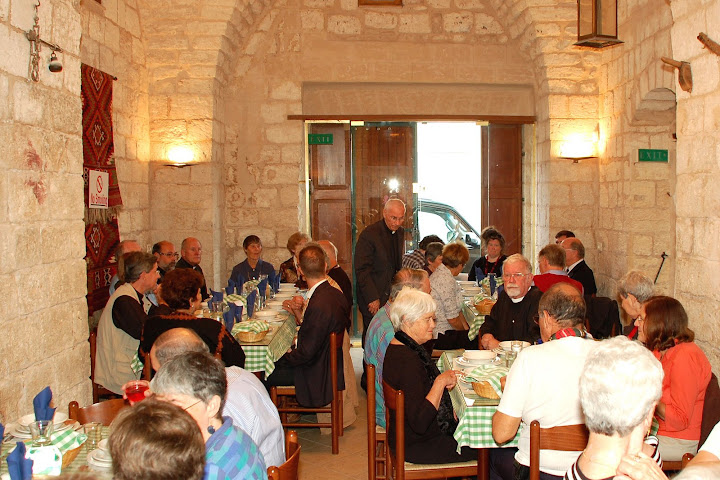
Mom got to see and/or speak with a number of people who have been in the international news. (My mother is the white haired grandmother seated at table in bottom right corner; photo is from Sabeel's slide show on their website).

Fawziya Khurd: My mother spoke with her in her tent in a parking lot in East Jerusalem. She was evicted from her home after settlers occupied it. She is living in the parking lot next to the home she lived in since the mid-1950s, and told my mother she is being fined close to $100 per day for living in a tent in the parking lot. To learn more, see details of Jonathan Cooks' reporting on this story, Who Will Stop the Settlers? in Counterpunch.

Samia Khoury: Mom writes: "When she stood up after Mr. Ben-Eliezer's speech and basically said we the Palestinians accept your apology it was so amazing that I was in tears."

Email from Samia Khoury to Sabeel conference attendees:

A short and small man physically, Josef Ben Eliezar stood tall as he asked for forgiveness from the Palestinians at the Sabeel 7th international conference on the Nakba: Memory Reality and Beyond which took place in Nazareth and Jerusalem (November 12-19, 2008). He shared with the participants his testimony for taking part in the expulsion of the Palestinian population from Lydda and robbing them of their money and personal possessions when he was an Israeli soldier in 1948.

Josef could not live with the reality of that day in July 1948. He realized then that what he was doing to the Palestinians was what the Nazis had done to his family and people before he had immigrated to Palestine after the holocaust. He did not find a listening ear in the newly established state of Israel, and the inhumanity of that war which as a Jew he thought was a war of liberation continued to pursue him until he eventually left the country and settled in England.

I wonder how many Israelis would have the courage and the magnanimity of Josef to admit that they have done the Palestinians wrong, let alone ask for forgiveness. Although his testimony was mostly in front of an international audience, yet there were a number of Palestinians from Jerusalem and Nazareth who heard him loud and clear. I was so moved that I felt I needed to get up and recognize his courage and thank him for his testimony assuring him that we do forgive him. (check out his book The Search)

As people came up to thank me later on for my words, I could not help but wonder how meaningful for the Palestinian people it would have been and how much suffering could have been spared had the Israelis since day one of the establishment of the state in 1948 admitted the wrong and grave injustice that they had inflicted upon the Palestinians, asked for forgiveness, and allowed all who were evicted to return to their homes. A dream that could still be realized if the Jewish people can ponder and act in accordance with the words of their great prophet Micah (6:8) " What does the Lord require of you but to do justice, and to love kindness, and to walk humbly with your God."

Samia Khoury

"Do unto texters as you would have lecturers do unto you"


The professors/bloggers over at "Rate your students" think they have a keen eye for edgy writing and expletive-laced colorful rage about the daily inanities of teaching -- and they do. I took up the challenge of responding to this query: "So what do you do about texting in your class" and they included my answer in their line-up -- mine is the third down., beginning: "I teach one of those 100-student things, but since I don't take attendance and my detailed PowerPoint lectures are all on-line, the crowd is cut down to about 70...."

Friday, November 21, 2008

Is homosexuality only "okay" if it isn't your choice?


As part of giving a lecture on homosexuality in my developmental psychology class, I looked up Lisa Diamond's new book, because in past year's I've had to point out that most of the work on homosexuality is on male homosexuality -- it feels funny to spend an hour on theories of why men become gay addressing a room of 70 students that is 85% female.

I'd read some journal articles by Dr. Diamond and knew she had a book coming out, Sexual Fluidity: Understanding Women's Love and Desire.

The following blurb is from University of Chicago Magazine:

Is love "blind" when it comes to gender? For women, it just might be. This unsettling and original book offers a radical new understanding of the context-dependent nature of female sexuality. Lisa Diamond argues that for some women, love and desire are not rigidly heterosexual or homosexual but fluid, changing as women move through the stages of life, various social groups, and, most important, different love relationships.
This perspective clashes with traditional views of sexual orientation as a stable and fixed trait. But that view is based on research conducted almost entirely on men. Diamond is the first to study a large group of women over time. She has tracked 100 women for more than ten years as they have emerged from adolescence into adulthood. She summarizes their experiences and reviews research ranging from the psychology of love to the biology of sex differences. Sexual Fluidity offers moving first-person accounts of women falling in and out of love with men or women at different times in their lives. For some, gender becomes irrelevant: "I fall in love with the person, not the gender," say some respondents.
Sexual Fluidity offers a new understanding of women's sexuality--and of the central importance of love.


See also this review.

While googling around, I stumbled upon the controversy regarding Dr. Diamond and NARTH (National Association for Research and Therapy of Homosexuality). NARTH has been citing Diamond's research as evidence that female homosexuality contains an element of choice, which supports their view that homosexuality can be changed. Diamond contests their misuse of her findings.

Sunday, November 9, 2008

"In the Black Hawk Simulator, participants experience flying through a mountain village whilst shooting at enemies"


In an effort to raise the profile of the US military, a mall in Philadelphia recently became home to the first Army Experience Center. (More from blog.800hightech.com)

Read the Military's own description at http://www.army.mil

See myspace video of kids mowing down simulated villagers.

Columnist Him Hightower criticizes this facility, which is in a huge space at an urban mall.

More videos.

Please comment.

Sunday, October 26, 2008

New project with students: Video games and language learning

In graduate school in cognitive science I studied artificial neural networks and language acquisition, a continuation of my interest in psychology and computer science from college.

As a professor, I became knowledgeable in several new areas during the 1990s. One of these is the question of why adults find it difficult to learn a foreign language, even in an immersion context. To answer this, I have been developing "multi-causal" theory: foreign language learning is difficult because of entrenched and routinized first-language structures, decline in brain plasticity, and decreased motivation to practice the second language because immediate rewards are so low. Adult learners may highly desire the end-state of fluency, just as they value other long-term goals like weight gain or smoking cessation; immediate rewards are minimal. The intervention I propose is a virtual reality learning environment. The virtual world is the place to learn and practice a foreign language with game characters providing language recasts and diverse skill levels. The immediate rewards of video-games (solving puzzles, finding clues) means that language learning is part of making progress in the game. After developing a prototype for foreign language learners, I want to extend the video game language learning project to the problem of literacy acquisition for deaf children. With my colleagues at BU, I argue that deaf individuals have difficulty learning to read because they are being asked to do something unprecedented: learn a second language (and sometimes a first language) via print. But can a language be learned just from print? Language learning is typically thought to depend on social-emotional interaction, which is absent when deaf children struggle to learn language from the printed page. Virtual reality environments can be used to immerse learners in a world where printed material can co-exist with interactions between characters, including interaction of the learner.

I'm currently looking for funding and collaborators and welcome suggestions.

Saturday, October 25, 2008

Which one of these is not like the others?

Below is an unedited email I received from my university Office of Sponsored Programs. Take a look at items 1-4 (see italicized text below).

AGENCY: Department of Health and Human Services (DHHS)/National Institutes of Health (NIH)

PROGRAM: Roadmap Transformative R01 Program (R01)

OBJECTIVES: This program, part of the NIH Roadmap Initiative, provides funding for exceptionally innovative, high risk, original and/or unconventional research with the potential to create new or challenge existing scientific paradigms.

Projects in any area of NIH interest are encouraged. Areas of highlighted need that have been identified through an NIH strategic planning process include: 1) Understanding and Facilitating Human Behavior; 2) Change Complex 3-Dimensional Tissue Models; 3) Functional Variation in Mitochondria in Disease Transitions from Acute to Chronic Pain; 4) Formulation of Novel Protein Capture Reagents; and 5) Providing an Evidence Base for Pharmacogenomics

Proposals must clearly articulate (a) the fundamental issue to be addressed and its overarching importance to the biomedical/behavioral research enterprise, (b) how the studies will either establish new or disrupt existing paradigms, and (c) how the proposed rationale and/or approaches significantly differ from state of the art in the field.

DEADLINES:
Letters of Intent (optional): December 29, 2008
Proposal submission: January 29, 2009
______________________________________________________________

See why the Annals of Improbable Research say that "Soft is Hard"?

Thursday, October 16, 2008

Why do people confess to crimes they didn't commit?


In a discussion of whether Dostoevky deserves to be considered a great writer, the blogger Jim H wrote:

does anyone really believe that Raskolnikov would cop so readily to the murder? Was he that weak? Was his conscience so overwhelming? or was this just a way for D. to end the story in a redeeming, sort of uplifting way he couldn't find it in himself to challenge?

Hm.... the question is a reminder that most people don't understand how easily people confess. Most people are surprised to learn how common is the phenomena of false confessions.

I just lectured on this in today's psychology class and can't get the topic off my mind.

I found I was unusually strident because my undergrads were staring at me with looks of disbelief and incomprehension.

One student said, "Because they want to protect their family?"

Silently... uh... no, that was Stalinist Russia.

The evidence that people confess to crimes they don't commit, and the reasons, were recently laid out by Saul Kassin (journal article, blog report), publication list).


Dear young things, only two in a class of 85 (yes, big classes sucks) indicated that they had heard of the "Central Park Jogger" -- the young female stock broker assaulted and left for dead in 1989. Media hysteria over teens going on "wilding" rampages meant that the usual suspects were rounded up and convicted. Five young black men spent the 1990s in jail and were finally released in 2002 when the real rapist, already in prison for another crime, bragged about the assault to an imate and was found to have been the rapist via DNA evidence.

They confessed because they cracked under the relentless pressure and just wanted the harassment to end.

It doesn't sound plausible, does it -- until you start looking at the data.

About 1/4 of DNA exonerations were for death-row inmates who were on death-row because of false confessions; once you make a confession, its not easily retracted.

Readers, what is the solution to the waste of lives mispent in jail and wrong convictions?